2048 version guide
2048 Variations: Which Version Should You Play?
The best 2048 variation depends on what you want to change. Cupcake and seasonal themes keep the familiar 4×4 rules, a 7×7 board creates longer planning runs, and rule-changing variants add undo, obstacles, new spawn patterns or different goals. This guide compares those choices without treating every reskin as a completely new game.
Quick answer: the main types of 2048 variations
Most 2048 variations change one of four things: the tile artwork, the board dimensions, the movement or spawn rules, or the final objective. A themed version such as Cupcakes 2048 is easiest to learn because the underlying powers-of-two progression stays familiar. A larger board is better for longer sessions, while reverse, obstacle or hybrid versions demand a new strategy.
Choose by the mechanic you want, not only by the thumbnail. Two games can look completely different yet play almost identically, while two plain-looking boards can require opposite decisions because their merge or spawn rules differ.
- Best familiar theme: Cupcakes 2048 on the classic 4×4 board.
- Best longer session: a 5×5, 6×6 or 7×7 version with more recovery space.
- Best strategy challenge: variants that change movement, goals, blockers or tile spawning.
- Best casual discovery: seasonal and character themes that preserve normal controls.
2048 variation comparison
Use this table to separate cosmetic themes from versions that materially change how you plan a board.
| Variation type | What changes | Best for | Main trade-off | Example on this site |
|---|---|---|---|---|
| Themed tiles | Numbers become cupcakes, characters, animals or other images. | Players who want clearer visual milestones or a friendlier look. | Artwork can hide the numeric value until you learn the order. | Classic Cupcakes 2048 |
| Larger board | The grid expands beyond 4×4, often to 5×5 or 7×7. | Long runs, experimentation and recovery practice. | More space makes early play easier but long-term organization harder. | 2048 Cupcakes 7×7 |
| Seasonal theme | Visuals and atmosphere switch for Halloween, Christmas or another event. | Short themed sessions with familiar rules. | It may add little mechanical depth if only the artwork changes. | Halloween and Christmas pages |
| Rule twist | Undo, blockers, different spawns, multiple merge directions or a new target. | Experienced players who want to relearn decision making. | Classic corner strategy may work only partially. | Use the rules checklist below |
| Hybrid game | 2048 merging is combined with Tetris-like placement, cards, physics or another genre. | Players who enjoy the merge loop but want a different pace. | The result may feel less like traditional 2048. | Compare before leaving the classic format |
Choose a 2048 version by the experience you want
A useful variation solves a specific preference. Start with the question below instead of opening random clones until one feels right.
I want the classic rules with better visual milestones
Keep the 4×4 grid and normal merge logic, but replace abstract numbers with a memorable tile sequence.
Pick Cupcakes 2048 or another well-labeled theme.
I want more room and fewer early dead ends
A larger grid gives you more feeder lanes and time to repair an uneven chain.
Pick the playable 7×7 version.
I already know the corner method
Look for obstacles, reverse goals, unusual spawn rules or limited movement so old habits are tested.
Pick a true rule-changing variant.
I want a quick change without learning again
Seasonal versions change the mood while keeping arrow-key or swipe controls familiar.
Pick a Halloween or Christmas theme.
1. Theme variations: the same puzzle with a different memory system
Theme-based 2048 versions are often dismissed as simple reskins, but a good theme can change how quickly a player reads the board. Numbers communicate exact value immediately. Images communicate identity and progression. In Cupcakes 2048, the challenge is learning which dessert comes next, then using that visual sequence as confidently as 2, 4, 8 and 16.
This category is best for new players, younger players and anyone who finds the original number grid visually dry. It is also useful when the artwork has a consistent order and the site provides a tile-value guide. A weak theme uses similar images, hides important differences or provides no value reference; that creates confusion rather than variety.
Searches for 2048 themes, character versions and visual variants usually share this intent. They should not automatically become separate articles. One comparison page can explain the category, while dedicated pages are justified only when a version has its own playable board, meaningful rules or a clearly different search task.
What stays the same
Four directions, equal-tile merges, a new low-value tile after a valid move and the need to protect empty spaces.
What the player must relearn
The image order, the visual identity of high tiles and whether the theme continues beyond the nominal 2048 goal.
2. Board-size variations: why 7×7 is not just easier 2048
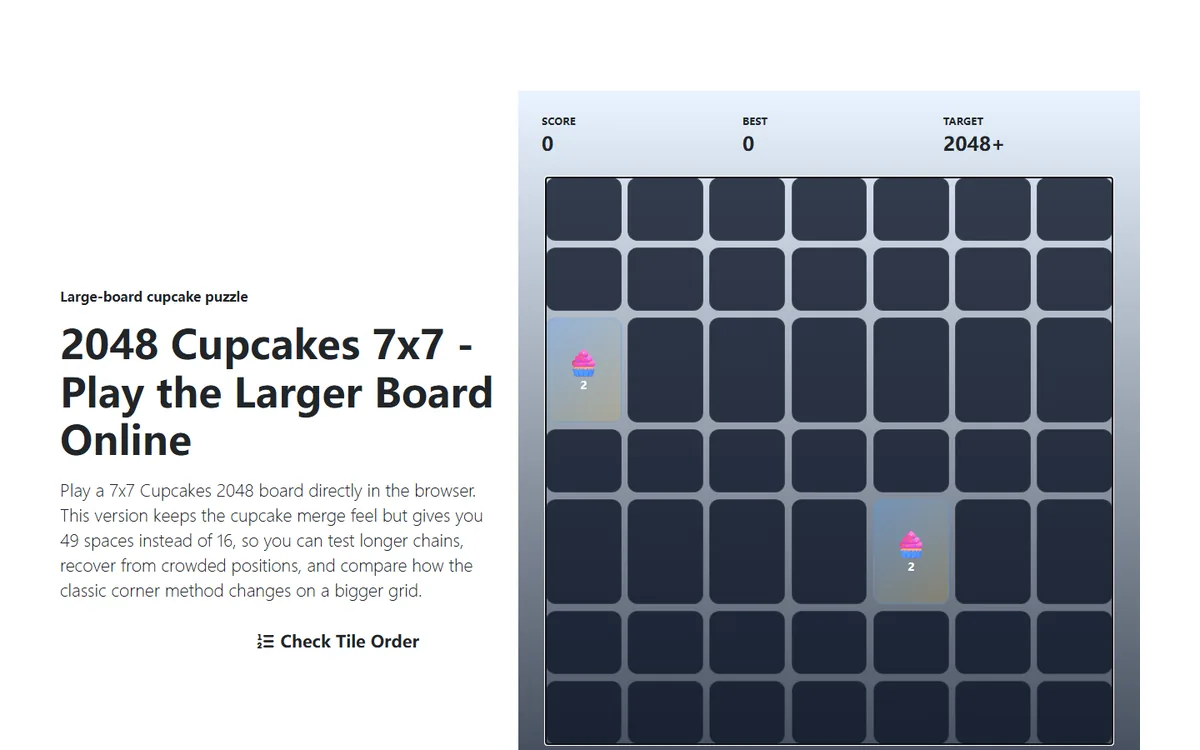
Classic 2048 uses sixteen cells. Expanding the grid changes far more than the amount of empty space. On a 7×7 board, early survival is easier because one mistake rarely ends the run. The strategic problem moves later: you must manage several feeder lanes, prevent medium tiles from spreading across the center and decide when to consolidate distant chains.
The classic corner method still provides a useful anchor, but two-direction autopilot becomes less reliable. Long rows can absorb many low tiles, and a careless sweep can pull an important chain away from the edge. Large-board play rewards periodic board audits: identify the highest tile, the active feeder lane, the most dangerous blocked row and the next pair you are building.
A larger board is therefore a practice environment, not a direct score comparison with 4×4. Scores, maximum tiles and run length should be compared only under the same board size and spawn rules. If a version includes undo, power-ups or custom spawns, those settings also belong in the comparison.
Try 7×7 when
You want longer sessions, space to test merge chains or a forgiving place to learn how feeder lanes work.
Stay with 4×4 when
You want the standard pressure curve, comparable personal bests and decisions where every empty cell matters.
3. Rule-changing and hybrid 2048 variants
A true 2048 variant changes the decisions, not merely the pictures. Common changes include an undo button, immovable blockers, tiles that spawn at different values, goals below or above 2048, reverse merging, custom board shapes and hybrids that combine sliding with falling pieces or card placement.
Before investing in a run, check five rules: which tiles can merge, where new tiles appear, whether every swipe creates a spawn, whether undo is limited, and what ends the game. These details determine whether the corner method remains strong. Blockers can make a fixed corner unsafe; reverse modes may reward keeping low values available; placement hybrids may care more about incoming-piece management than swiping rhythm.
The phrase games like 2048 can include games that share only a merge loop. That is useful for discovery but too broad for a promise that every result feels like 2048. A better comparison explains the preserved mechanic: sliding a full grid, combining equal values, building an exponential chain, managing space or chasing an endless score.
Undo variants
Good for analyzing accidental inputs, but unlimited undo makes score comparisons less meaningful unless the rules are disclosed.
Reverse or subtraction variants
They change the value goal and can punish habits learned from standard doubling.
Obstacle variants
Fixed cells divide the board and make flexible lane planning more important than a single permanent corner.
Genre hybrids
They preserve merging but add timing, placement or physics, so evaluate them as related games rather than standard clones.
4. How to judge whether a 2048 version is worth playing
A useful 2048 version should explain its rules before or near the playable area, respond to keyboard and touch input, preserve a readable relationship between tiles and values, and state whether scores are stored locally or compared publicly. If the game is embedded from another source, the page should also provide a fallback link or loading note instead of pretending every network will display the frame correctly.
Avoid versions that demand an unrelated installer, browser extension or account for a puzzle that can normally run in a webpage. Treat claims such as official, safest, world record or unlimited as unverified unless the page identifies the creator, rule set and source. A themed clone can still be enjoyable without making those claims.
For this site, start with the main Cupcakes 2048 board if you want standard play, use the all-cupcakes guide when the images are unfamiliar, open the 7×7 version for a real board-size change, and use seasonal pages when you want the same basic loop with a different atmosphere.
Rules visible
The page tells you the grid size, merge rule, goal, spawn behavior and whether undo or power-ups exist.
Controls work
Arrow keys and swipes respond reliably, with restart and fullscreen controls labeled clearly.
Values remain readable
Artwork, labels or a companion guide make the tile order understandable without guessing.
Claims stay comparable
Scores specify board size and special rules instead of mixing classic, edited and assisted runs.