Large-board 2048 guide
2048 8x8: Is the Bigger Board Easier? Strategy and Rules Guide
A 2048 8x8 board gives you 64 cells instead of the classic 16. That extra room makes the opening more forgiving, but it also creates more lanes, more drifting tiles, and more late-game decisions. This guide explains what changes, which classic habits still help, and how to compare an 8x8 run without treating every implementation as the same game.
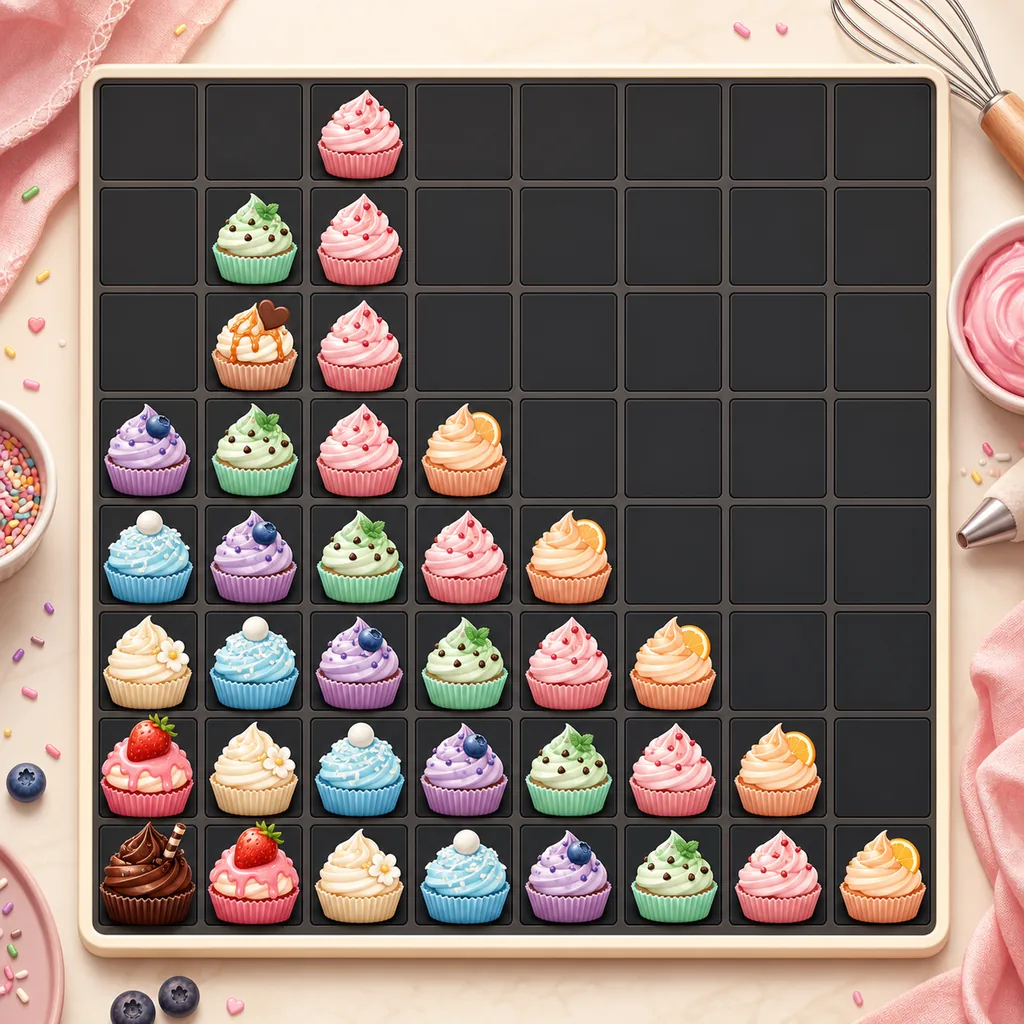
Quick answer: 2048 8x8 is more forgiving first, not automatically easier
The short answer is conditional. With 64 cells, an 8x8 board usually gives a beginner more time to recover from an awkward move than a 4x4 board. The challenge arrives later, when smaller tiles can spread across several rows and the open center makes a weak position look safer than it is.
There is also no single universal 2048 8x8 rule set. Some pages keep normal equal-tile merges, while others change the spawn pattern, target, undo behavior, or scoring. Check the actual implementation before comparing it with classic 2048 or calling a score a record.
For practice, learn the normal corner method on 4x4 first, use the site's 7x7 page to feel the larger rhythm, and then treat 8x8 as a lane-management problem rather than a sequence of automatic swipes.
- 64 cells create more opening space than a classic 4x4 board.
- More space can hide scattered medium tiles until the late game.
- Board size alone does not prove that spawn, scoring, or undo rules are unchanged.
- Keep board size and special settings with every personal score.
2048 4x4 vs 7x7 vs 8x8 vs 9x9
Use this table to compare the planning problem, not to rank every board with one universal score. The 8x8 row is the focus of this guide; the other rows provide context for choosing a practice step.
| Board | Space | Planning pattern | Best for | Main caution |
|---|---|---|---|---|
| Classic 4x4 | 16 cells and fast pressure | One corner and a compact snake are easy to inspect | Learning the standard merge loop | One bad move can close the board quickly |
| 7x7 | 49 cells and longer recovery windows | Several feeder lanes can share one protected edge | Feeling how a larger board changes rhythm | The center can become disorganized without warning |
| 8x8 | 64 cells with a wider middle | An anchor plus repeated lane audits | Practising space management before very large boards | Extra cells can delay, rather than prevent, a dead end |
| 9x9 | 81 cells and very wide lanes | More active lanes and longer distances | Studying large-board organization | Implementations may use different rules and targets |
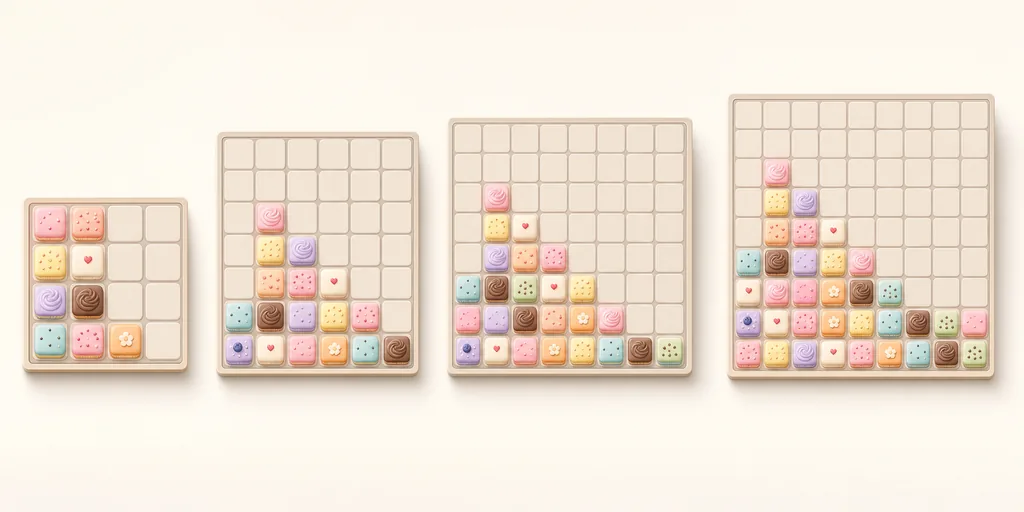
What a 2048 8x8 board actually changes
The obvious change is capacity: an 8x8 grid has 64 cells, four times as many as the classic 4x4 board. That extra capacity means a single weak swipe is less likely to fill every useful lane immediately. It does not make every future merge safe. New tiles can settle farther from the edge you want to protect, and several small chains can develop at once.
The most important difference is the change in attention. On 4x4, you can often see the whole position in one glance. On 8x8, look for the protected edge, the next useful pair, the blocked lane, and the empty cells that still give new tiles a route. A large board rewards short audits more than memorized move strings.
More recovery space
A weak opening move is less likely to end the run immediately.
More active lanes
Extra cells also give small tiles more places to drift away from your main chain.
How to adapt the corner method on 8x8
The corner method still gives the largest tile a predictable home. Choose one corner or edge, keep the high tile there, and build a descending chain toward it. The difference is that an 8x8 board gives you more feeder lanes, so you should not allow every attractive merge to occupy the center.
Before a move, ask three questions: where will the largest tile land, which empty cell could receive the next spawn, and does the next merge still have a route? If a move improves the score but breaks the protected edge, it is often a poor trade. Consolidate a lane before chasing a distant pair.
Anchor one side
Keep the highest tile and the next values on a predictable edge instead of rotating the board plan.
Protect a feeder lane
Leave one route open for low tiles so future merges can reach the anchor.
Audit before sweeping
Use a pause to check the next pair and the most dangerous new spawn.
Rules to check before you compare an 8x8 score
The phrase 2048 8x8 describes a board dimension, not one official product. Confirm the grid size, equal-tile merge rule, new-tile value, number of tiles spawned after a valid move, target tile, and end condition. An implementation that generates two tiles per turn can feel very different from one that follows the classic rhythm.
Also record whether undo, hints, power-ups, autoplay, or local score editing is available. Those features can be useful for learning, but they change what a score means. A personal benchmark is still valuable when the board size and settings are written beside it.
Board and spawn
Verify 8x8 dimensions, spawn values, spawn count, and whether every empty cell is eligible.
Controls and recovery
Check keyboard, swipe, restart, fullscreen, undo, and any assistance before playing.
Comparable records
Keep classic, 7x7, 8x8, and 9x9 scores in separate lists.
A beginner practice path for 2048 8x8
Start on a classic 4x4 board until you can protect one corner without relying on a fixed swipe script. Then use the 7x7 page to practise leaving a feeder lane open. The goal is not to chase a larger number immediately; it is to notice how extra space changes the timing of consolidation.
On 8x8, use the spare cells to prepare merges, not to postpone every decision. When the center begins to fill, bring medium tiles back toward the protected edge and remove isolated pairs. If a move cannot be explained in terms of anchor safety, lane access, or a planned merge, pause and choose a clearer alternative.
Learn the loop
Know how equal tiles merge and how a new tile appears before testing a larger board.
Keep one route
An open lane is useful only when it leads toward a planned merge.
Write down settings
Record dimensions, target, spawn behavior, and undo rules with the result.
Read these Cupcakes 2048 guides next
2048 8x8 questions
References for the classic 2048 background
Board-size variants do not have one universal rulebook. These sources support the classic game context and show examples of variant implementations; they are not proof that every 8x8 page is official or identical.
- Gabriele Cirulli's 2048 open-source project — The public source repository for the classic 2048 project and its standard 4x4 game context.
- 2048.ninja larger-board examples — A public variant site used only as an example that larger boards can have their own implementations and settings.