Strategy Guide
2048 Cupcakes Strategy: How to Win with the Corner Method
The best 2048 Cupcakes strategy is not random swiping. Pick one corner, keep your highest cupcake there, build a descending chain beside it, and make every small merge feed that chain. This guide turns the familiar 2048 corner method into a Cupcakes 2048 plan you can follow from the first move to the Rainbow Cupcake.
Quick Answer: What Is the Best 2048 Cupcakes Strategy?
The safest way to win 2048 Cupcakes is the corner method. Choose one corner, usually bottom-left or bottom-right, and keep your largest cupcake tile locked there. Then arrange the next largest cupcakes in descending order along the same row or column, such as 1024, 512, 256, 128. That order gives every new small cupcake a path to grow without pushing your best tile into the center.
This approach works because 2048 Cupcakes uses the same merge logic as classic 2048. The artwork changes, but the board problem stays the same: high-value tiles become hard to combine when they are scattered. A stable corner turns the board into a funnel. Low cupcakes enter from the open side, merge into mid-value cupcakes, and eventually feed the row that creates 1024 and 2048.
Do not treat the strategy as a magic swipe pattern. You still need to watch the board. Use two main directions that push toward your corner, use a third direction only when it keeps the chain intact, and avoid the fourth direction unless the highest cupcake is protected. The goal is not to merge everything immediately; the goal is to preserve a board shape that keeps future merges possible.
What This Guide Covers
- How to win 2048 Cupcakes
- Corner method setup
- Snake chain order
- Board recovery moves
- Score and Rainbow Cupcake goals
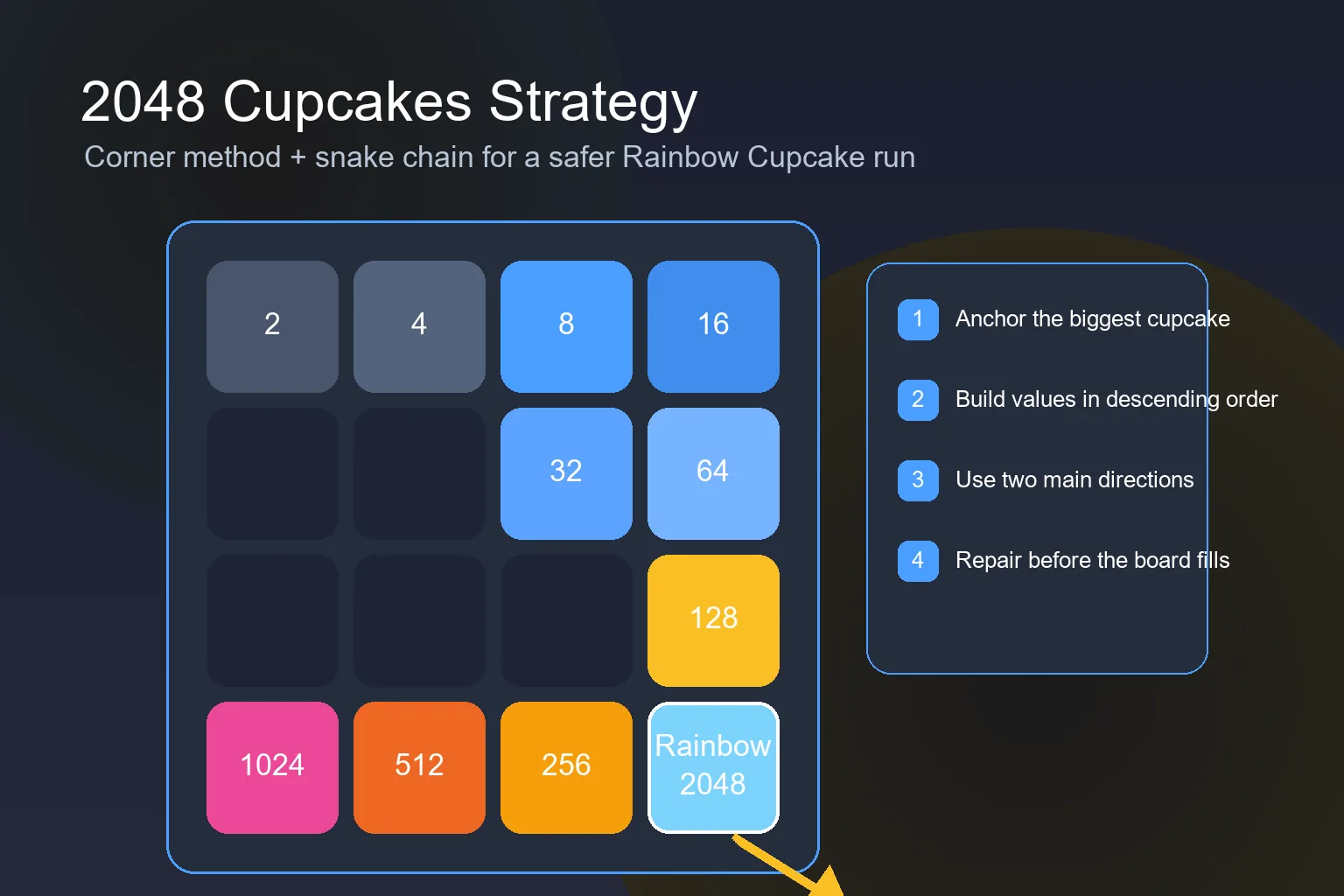
The Corner Method for 2048 Cupcakes
Start by choosing the corner where your highest cupcake will live. If you choose the bottom-right corner, your main moves should be down and right. If you choose the bottom-left corner, your main moves should be down and left. The exact corner is less important than consistency. Switching corners mid-game usually scatters the chain and creates isolated high tiles.
Once the highest cupcake reaches the corner, build a descending line beside it. Think of the line as a conveyor belt: the highest tile sits at the end, and every smaller tile moves toward it in order. A board with 512, 256, 128, and 64 touching each other is easier to improve than a board where 512 is in one corner and 256 is trapped on the opposite side.
The hard part is refusing tempting merges. A merge in the middle may look useful, but if it opens a gap near your anchor, a new low cupcake can appear where your 512 or 1024 should stay. Before every swipe, ask whether the move protects the anchor, preserves the chain, and leaves enough empty cells for the next two turns.
| Stage | Best Action | Why It Works |
|---|---|---|
| Opening | Pick one bottom corner and use two primary directions. | Early consistency prevents your first 64 or 128 cupcake from drifting into the center. |
| Middle game | Build a descending row or column beside the highest cupcake. | A clean value ladder lets small merges feed bigger merges in sequence. |
| Late game | Protect the 512 and 1024 cupcakes even if a smaller merge is available. | One broken high tile can cost more than several missed low-value merges. |
| Recovery | Stop chasing score and rebuild empty space first. | A board with open cells can recover; a full board with scattered values usually cannot. |
| Two-move check | Before swiping, name the next merge and the merge after it. | Planning two moves ahead prevents a useful 64 or 128 cupcake from becoming an isolated blocker. |
How to Choose the Best 2048 Strategy
For searches such as 2048 strategy, 2048 game strategy, how to win 2048, and how to beat 2048, the common thread is preserving board shape rather than memorizing a fixed swipe pattern.
2048 strategy is a board-control problem
The corner method works because it protects a high tile while the snake chain feeds it. The best move is the one that keeps future merges possible, not always the move that scores immediately.
How to win 2048 without a fixed script
Use two main directions, inspect the next spawn, and leave open cells near the feeding side. A repeatable checklist is more reliable than copying a move sequence from another board.
How to beat 2048 when the chain breaks
Stop trying to rescue every tile. First restore empty space, then rebuild the descending order around the safest corner. Recovery is part of the strategy, not a failure of it.
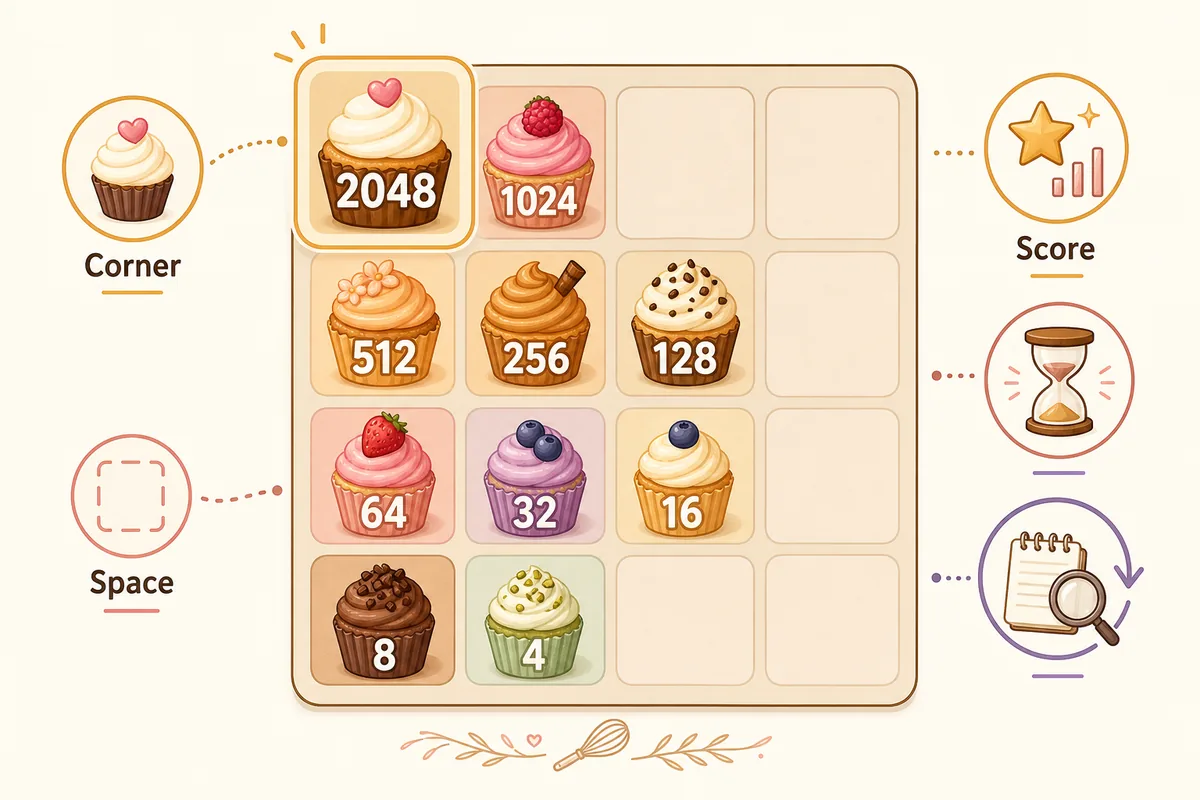
How to Build the Snake Chain
The snake chain is the advanced version of the corner method. Instead of keeping only one row organized, you let the values wrap across the board in a predictable path. For a bottom-right corner, the ideal chain might run from the bottom-right to the bottom-left, then up one row and back toward the right. This creates a long ordered path for values to travel.
You do not need a perfect snake to reach the Rainbow Cupcake, but the idea helps you judge moves. A good move keeps values flowing toward the largest cupcake. A bad move creates a high tile outside the path or breaks a pair that was almost ready to merge. When in doubt, favor the move that keeps the biggest four or five cupcakes touching the same edge.
A practical checkpoint is the 256 tile. If your 256, 128, and 64 cupcakes are already near your chosen corner, keep playing the structure. If those tiles are separated, slow down and rebuild before pushing for 512. Many losing boards happen because players rush to make one large tile while the rest of the board has no order.
Keep the highest tile fixed
Never move the largest cupcake away from the chosen corner unless the move immediately restores it or prevents a game-ending board.
Feed the low end
Use 2, 4, 8, and 16 cupcakes to build toward 32 and 64 before trying to merge larger tiles.
Protect empty cells
Empty space is strategic fuel. It gives new cupcakes room to appear without blocking the value ladder.
Delay risky swipes
If a move would lift the anchor out of the corner, look for a safer setup move first.
What Is the Strategy to Win 2048 Cupcakes?
The short answer is: choose one corner, keep the largest cupcake there, and make every other move support a descending chain toward that corner. This is the answer most players need when they search for what is the strategy to win 2048 Cupcakes.
Use the two directions that push into your chosen corner as your default moves. A third direction is allowed only when it keeps the chain intact. The opposite direction is your emergency move, because it can pull the highest cupcake away and open the corner to a low-value spawn.
If the board becomes messy, stop chasing score. Rebuild the edge first, merge blockers near the anchor lane, and keep at least two empty cells before trying another 512 or 1024 push.
Best fit
Use this method when your goal is a normal 2048 Rainbow Cupcake win.
FAQ fit
The exact question belongs in the FAQ and supporting copy, not in a separate page.
Move Decision Checklist
Before each move, ask four questions: does this keep the highest cupcake in the corner, does it preserve the descending chain, does it create or protect empty space, and does it help the next two merges? If a move fails two of those checks, wait for a safer setup.
This checklist is especially useful after 512, when a single careless swipe can separate the tiles you need for 1024. Slow play beats fast swiping because every new cupcake spawn can either feed the chain or block it.
Protect the anchor
The largest cupcake should not leave the chosen corner unless it returns immediately.
Read the next merge
Look for the smaller pair that will feed your 64, 128, or 256 path.
Keep two spaces open
Two empty cells give you room to absorb bad spawns and recover.
Skip flashy merges
A merge in the center is not worth breaking the edge chain.
Common Mistakes That Stop a 2048 Cupcakes Win
The most common mistake is swiping in all four directions just because a merge is visible. In Cupcakes 2048, every move changes the whole board, not just the two cupcakes you want to combine. A single upward swipe can pull the anchor out of a bottom corner and invite a new low tile into the anchor space.
Another mistake is letting mid-value cupcakes float. A 128 or 256 tile in the center is not automatically good; it may become a wall that blocks smaller tiles from reaching the chain. Move mid-value tiles toward the chosen edge as soon as possible. If they cannot reach the edge, try to build their matching partner nearby instead of creating another isolated tile.
Players also restart too late. If your highest cupcake is trapped away from the corner and the board has only one empty cell, the win chance is already low. Use that failed board as practice: study which move broke the chain, then restart with the same corner and avoid that pattern next time.
Do not chase every merge
A merge is only valuable when it improves the chain or creates space without damaging the anchor.
Do not split high cupcakes
Keep 512, 256, and 128 close enough that they can combine later.
Do not ignore spawn risk
Every move adds a new tile, so empty anchor spaces are dangerous when the highest cupcake can slide away.
Do not panic in the late game
Late boards need slow, deliberate recovery moves more than quick score gains.
How to Recover When the Board Breaks
A broken board is not always lost. First, identify the highest cupcake and the nearest path back to your chosen corner. If the tile is one move away from the corner and that move will not destroy the chain, take it. If it is blocked by smaller tiles, merge those blockers only if the merge creates space along the route.
Second, stop building new high tiles until the anchor is safe. Creating another 256 on the opposite side feels productive, but it can make recovery harder. Your priority is to reduce clutter near the anchor lane, restore one ordered row or column, and leave at least two empty cells so the next spawn does not trap you.
Third, accept that recovery may cost a few turns. The best 2048 strategy is often defensive. A move that creates no immediate merge can still be correct if it rebuilds the shape of the board. Once the anchor and chain are stable again, return to normal growth.
Score Goals: From 512 to the Rainbow Cupcake
For most players, the first real milestone is 512. Reaching 512 with a clean chain means you understand the board. Reaching 1024 means you have protected the corner long enough to build a second high tile. The Rainbow Cupcake at 2048 usually requires repeating the same process twice: build one 1024, anchor it, then build another 1024 beside it.
If you want higher scores after 2048, keep the same method. Do not celebrate by loosening the structure. A post-win board still needs the largest cupcake anchored, a descending row, and enough open cells. The difference is that mistakes are more expensive because every high tile takes many small merges to replace.
A good score in Cupcakes 2048 is not just the number shown at the top of the game. A stable board with 1024, 512, 256, and 128 aligned is stronger than a higher score with tiles scattered everywhere. Judge progress by board control first and score second.
Practice Plan for Beginners
Play short practice rounds with one rule at a time. In the first round, focus only on never moving the highest cupcake out of your chosen corner. In the second round, focus on keeping the top four values on the same edge. In the third round, focus on leaving empty space before every risky move.
After each loss, do a quick review. Which move pulled the highest cupcake away? Which tile blocked the 128 or 256 from merging? Did you swipe because it looked available, or because it improved the chain? This review is more useful than simply playing faster.
When the structure becomes familiar, practice on the live game page and the unblocked page. Use the all-cupcakes guide when you want to connect each value milestone with the cupcake artwork, especially the 1024 cupcake and Rainbow Cupcake.