2048 Rules and Recovery
2048 Game Over: How to Check Your Board and Keep Playing
2048 game over does not mean that the board merely looks crowded. The real loss condition is a full board with no empty cell and no legal slide or merge in any direction. This Cupcakes 2048 guide gives you a quick answer, a row-by-row and column-by-column check, and a calm choice between undoing, continuing, or starting a new run.
8 minute read · Rules checked on November 15, 2026
The short answer
2048 game over happens only when every cell is occupied and no two touching tiles share a value. A full board can still be alive if one horizontal or vertical pair can merge, or if a slide would move a tile into an empty cell. Reaching the 2048 tile is a goal, not an automatic loss or a forced ending; you can keep playing after the win message when the board has a legal move.
To check a suspicious position, look for an empty cell first. If there is one, the board is not over. If the board is full, compare each tile with the tile to its right and the tile below it. One matching neighbor means a merge is available. Only after every comparison fails should you call the run game over.
- Full board: Necessary for a normal 4x4 game-over state, but not sufficient by itself.
- No legal move: Every row and column must be unable to slide or merge.
- After 2048: Choose Keep Going when you want a 4096 attempt; the goal tile does not end the board.
What 2048 Game Over Actually Means
The phrase 2048 game over describes a board state, not a score. The game checks whether the requested swipe can change anything. A move is legal when at least one tile slides into an empty space or two equal neighboring tiles combine. When neither event is possible for up, down, left, or right, the board manager has no next state to create and shows the end message. The same idea applies to the cupcake artwork: the pictures change, but the movement and merge test still uses tile values.
This definition separates three moments that players often mix together. Making a 2048 tile is a win milestone. Filling the grid is a warning because it removes empty space. A true loss occurs only when a filled grid also has no adjacent equal values. If you can point to one legal slide or one matching pair, the run is still alive even if the score panel feels frozen.
Win is not loss
The Rainbow Cupcake can appear while legal moves remain; use Keep Going for a longer run.
A move must change the board
A blocked swipe is a no-op and does not create a new tile or advance the game-over test.
Values matter
Artwork and color are visual labels; two touching tiles can merge only when their numeric values match.
The check is directional
A board that cannot move left may still move up, down, or right, so test all four directions.
A Full Board Is Not Always Game Over
A full board is the most visible warning, but it is not the complete rule. Imagine a 4x4 grid with every cell filled and two 32 tiles touching in the second row. A left or right swipe can combine that pair, open a cell, and allow the next random cupcake to spawn. The board looked full, yet it had a future state. Calling game over at the first full screenshot would incorrectly discard a playable position.
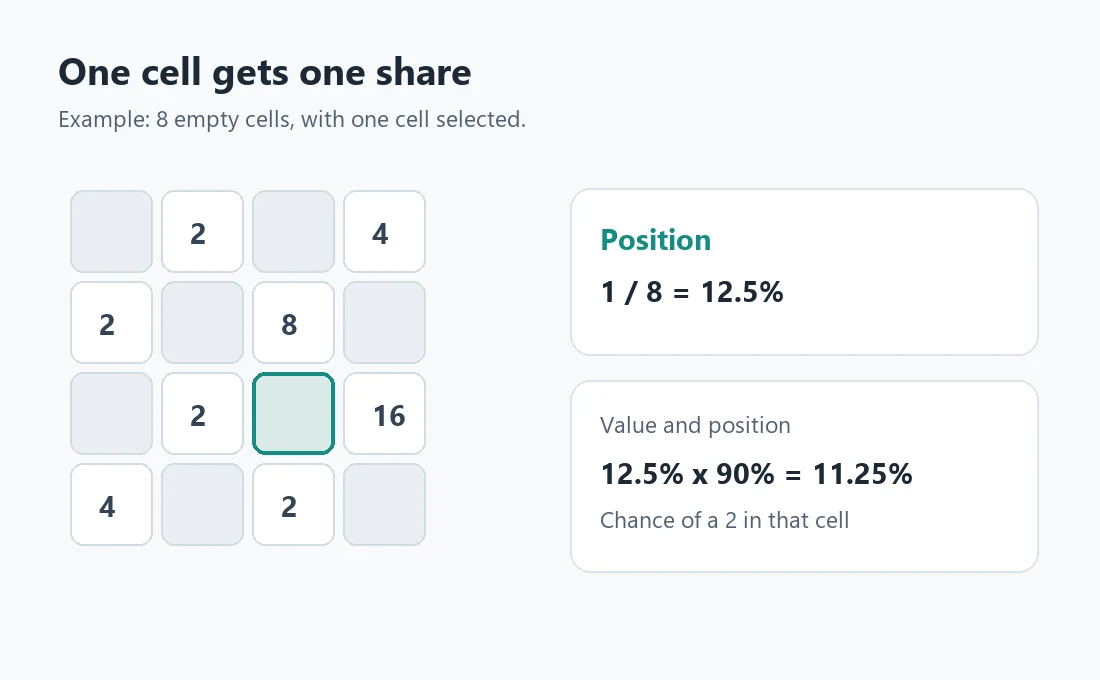
The reverse mistake is also common: players see no obvious pair and restart without checking a vertical neighbor. Merges are possible in columns as well as rows. Scan from the top-left, compare each tile with the one immediately to its right and immediately below it, and continue until the bottom-right corner. This avoids counting the same pair twice while covering every possible adjacent merge.
| Board state | Can the run continue? | What to do |
|---|---|---|
| At least one empty cell | Yes | Look for the safest slide and protect space. |
| Full, with an adjacent equal pair | Yes | Swipe toward the pair and recheck the new space. |
| Full, no equal horizontal or vertical pair | No | Record the result, undo if available, or restart. |
| 2048 tile reached with space left | Yes | Keep Going if you want to build 4096 or higher. |
How to Check Every Row and Column
When you need to know when 2048 is over, use a repeatable scan instead of guessing from the animation. First count empty cells. Any empty square means a tile can move into it eventually, so the game is not locked. Next read each row from left to right. Mark a match whenever two neighboring numbers are equal; the pair can merge when a swipe brings them together. Do not compare tiles separated by a different value because a merge requires adjacency after the slide rules are applied.
Then repeat the same comparison vertically, reading each column from top to bottom. A pair such as 64 above 64 is enough to keep the board alive even when every row looks different. Finally, consider movement into gaps: a row with values 2, empty, 8 can slide even though no merge exists. The test is complete only when there are no gaps and no equal horizontal or vertical neighbors.
Step 1: count spaces
Find every empty cell before looking at merges; one space means the board is still playable.
Step 2: scan rows
Compare neighbors in each row and note any equal pair that a horizontal swipe could join.
Step 3: scan columns
Compare neighbors in each column so a vertical merge is not missed.
Step 4: test a direction
If the board is full and has no pair, each direction should leave every tile in the same place.
| Question | If yes | If no |
|---|---|---|
| Is any cell empty? | Continue; choose a space-preserving move. | Go to the neighbor checks. |
| Do two horizontal neighbors match? | The board is alive; plan that merge. | Check the next row. |
| Do two vertical neighbors match? | The board is alive; plan that merge. | Check the next column. |
| Can any direction slide a tile? | Continue and watch the new spawn. | The position is game over. |
What Happens After the Game Over Screen
Once the game reports 2048 game over, pause before pressing New Game. If the last move was accidental and the page offers Undo, step back once and inspect the previous board. Undo is a recovery tool, not a guarantee: it may return you to a position with only one safe move, and using it repeatedly can make it harder to remember which board shape you were protecting. Save a screenshot or note the largest tile before experimenting.
If the position is genuinely locked, keep the result as a practice checkpoint. Write down the board size, largest cupcake, score, and the first move that removed your last safe lane. Then restart with a clear corner and a space goal. Players who want to continue after the 2048 win should select Keep Going before the board locks; the end screen after a loss cannot create another tile by itself.
Undo
Use one undo to reverse a known mistake, then verify that the restored board really has a safer next move.
Keep Going
Choose it after reaching 2048 when you want to pursue a 4096 or 8192 target.
Restart
Start fresh when the board is locked and the undo history cannot restore useful space.
Review
Record the board conditions so a high score remains comparable to another Cupcakes run.
How Board Size Changes the Check
The game-over rule is the same on every square board, but the amount of scanning changes. On a 3x3 board, one blocked corner can remove most of your options quickly. A classic 4x4 board has sixteen cells, so checking three adjacent pairs per row and three per column is manageable. On 7x7, 8x8, or 13x13 Cupcakes boards, a full scan takes longer, and a distant matching pair is easier to overlook when the board is visually busy.
Larger boards usually give you more empty cells and more time before the first lock, but they do not remove the need for a systematic check. A 13x13 board can be full and still have a legal merge at the far edge. Use the same top-left-to-bottom-right path every time, and treat the board size as a reason to slow down rather than a reason to declare the run finished early.
| Board | What changes | What stays the same |
|---|---|---|
| 3x3 | Very little spare space; inspect after every move. | Full plus no adjacent equal values means game over. |
| 4x4 | Classic layout; a four-direction check is quick. | A full board can still merge. |
| 7x7 or 8x8 | More cells and longer rows make missed pairs likely. | Compare every horizontal and vertical neighbor. |
| 13x13 | Scan deliberately in sections so the far edge is not skipped. | An empty cell or one legal move keeps the game alive. |
Preventing Game Over Without Chasing Scores
Avoiding 2048 game over is mostly a space-management habit. Keep the largest cupcake anchored in one corner, build a descending edge, and leave at least one or two empty cells near the side where new tiles can enter. The goal is not to create a merge on every turn. A quiet move that preserves a lane is often safer than a flashy merge that fills the last open square and strands the high tiles in the center.
Before each swipe, name the next merge and the space it will open. If you cannot identify either, choose the direction that keeps your anchor and the longest edge chain intact. A blocked direction is harmless because it adds no new tile, but repeatedly pressing it is not a strategy; use the pause to inspect the other directions. When the board begins to tighten, protect options first and score second.
Protect a corner
Keep the highest cupcake in one chosen corner so a new low tile cannot split your chain.
Preserve a lane
An open row or column gives future tiles somewhere to slide before they become blockers.
Plan two moves
Check where the current merge lands and whether the following spawn can be absorbed.
Stop score chasing
When space is scarce, a defensive move can be the only move that avoids a locked board.
A Calm Recovery Checklist Before Restarting
A near-loss deserves one deliberate review. Start at the corner holding your largest cupcake and trace the edge toward the smallest feeder tiles. If the chain is intact, make the move that opens space even when it produces no immediate score. If the chain is broken, locate the closest equal pair and decide whether merging it will free the anchor lane or merely create another wall. This is a board-shape decision, not a race to the next number.
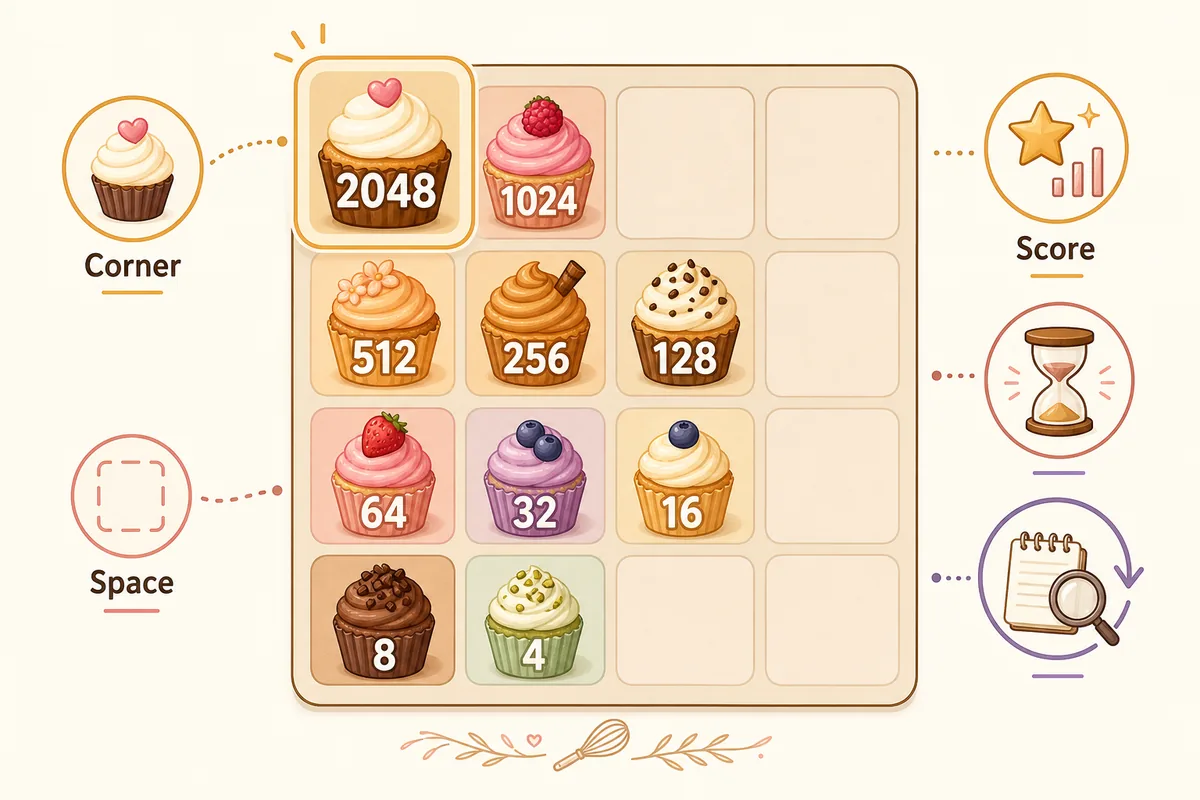
After a true game over, ask three questions: which empty cell disappeared first, which swipe pulled the anchor away, and which alternative direction was still available at that moment? The answers make the next run more useful. Use the playable Cupcakes page to practice one correction at a time, then return to this check whenever the board looks full but the status is unclear.
2048 Game Over FAQ
Rule sources
The game-over explanation was checked against public 2048 rule pages and a focused no-moves explainer. Those sources agree that a full board is not enough; every direction must be unable to change the board.
- 2048 Original support rules states that the game ends when the board is full and no more moves are possible.
- 2048 video game overview separates the 2048 goal from continuing to create larger tiles.
- When 2048 Is Game Over shows the full-board and adjacent-pair distinction in a focused rules page.
Related Cupcakes 2048 pages
- 2048 Cupcakes Strategy · Use corner control and a descending chain to keep legal moves available.
- 2048 Tile Spawn Probability · See when a changed move creates a tile and why a blocked swipe does not.
- 2048 Cupcakes High Score · Compare score goals only after the board conditions are clear.
- Play Cupcakes 2048 Unblocked · Practice the row-and-column check on the playable browser board.