2048 Game Mechanics
2048 Tile Spawn Probability: How 2s, 4s, and Empty Cells Work
2048 tile spawn probability has two separate parts: the new tile is usually a 2, and its position is chosen from the empty cells. In the standard game and the Cupcakes version, a value draw gives a 2 a 90% chance and a 4 a 10% chance. This guide explains when that draw happens, how to calculate one cell's odds, and why a blocked swipe creates nothing.
7 minute read · Checked against the game source on November 4, 2026
The short answer
After a move that changes the board, standard 2048 draws a new value: 2 with probability 0.9 or 4 with probability 0.1. It then chooses a location from the board's currently empty cells. The value draw and location draw answer different questions, so do not treat 90% as the chance that a particular square receives a 2.
If there are n empty cells, one named empty cell has a 1/n chance of being selected. Its chance of receiving a 2 is 0.9/n; its chance of receiving a 4 is 0.1/n. A move that leaves every tile in place skips the spawn step.
- Value: 90% for a 2 and 10% for a 4 on each spawn.
- Position: Each empty cell shares the location chance equally.
- Timing: A changed board spawns; an unchanged move does not.
What the 90% and 10% odds mean
For 2048 tile spawn probability, the familiar 90/10 rule describes the value of one newly created tile. For every normal spawn, the game makes a random draw: nine outcomes out of ten are a 2 and one outcome out of ten is a 4. The odds do not say that every tenth tile must be a 4. They describe a long-run rate, so a short run can contain several 2s in a row or two 4s close together.
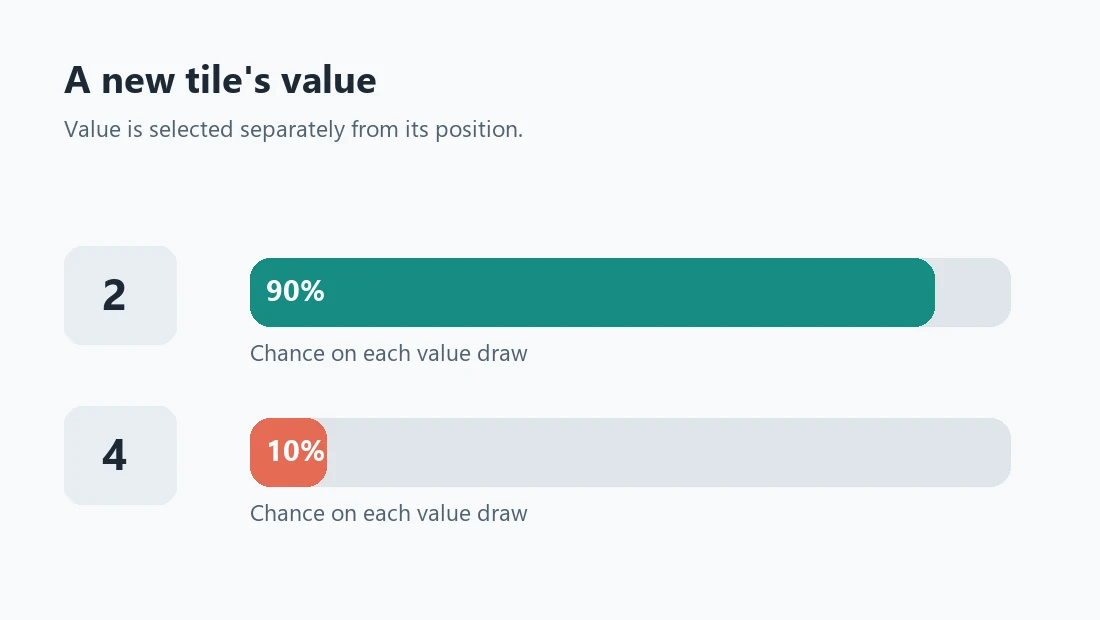
A 4 is uncommon, not a special reward for making a large merge. The draw occurs after a successful board change and does not depend on the score, the swipe direction, the size of the merged tile, or how long the current game has lasted. If you are asking when does 2048 spawn a tile, the key condition is a valid move, not a particular kind of merge.
The tile value and its location are separate draws
The 2048 tile spawn probability is easier to calculate when value and location are treated as separate draws. After choosing whether the new tile is a 2 or a 4, the game picks one of the cells that is empty. In the original 2048 code, the available-cell list is built from empty grid positions, and the random index selects one position from that list. That makes the location chance uniform across the available cells: an empty corner is not favored over an empty center cell.
This separation is the useful way to understand 2048 new tile chance. First ask how many cells are empty. That gives the chance for any new tile to land in one chosen cell. Then multiply by 90% or 10% to get the chance for a particular value in that cell. Occupied cells have no spawn chance, and the list is recalculated after each move because the board has changed.
When a new tile appears, including at the start
The opening board follows the same 2048 tile spawn probability model: a fresh game is set up by placing two starting tiles. The standard game manager calls the same random-tile routine for both placements, so each starting tile uses the same 2-versus-4 value rule and an available empty position. These two setup spawns happen before the first swipe. If a saved game is restored, the game loads its saved board instead of creating another opening pair.
During play, the game first applies the requested direction and checks whether any tile changed position. If at least one tile slides or merges, a new tile is added to an empty cell. A legal slide can therefore create a tile even when no merge occurs. This distinction matters: players sometimes count only merges as successful moves, but the game counts a changed board.
Calculate the chance for one empty cell
To calculate 2048 tile spawn probability for one empty cell, let n be the number of empty cells just before the spawn. Each one has a 1/n chance of receiving the next tile. For a specific cell, the chance of a 2 is 0.9 multiplied by 1/n, and the chance of a 4 is 0.1 multiplied by 1/n. Add those two outcomes and the chance of any tile in that cell returns to 1/n. The formula assumes that the cell is empty and that the move triggered a spawn.
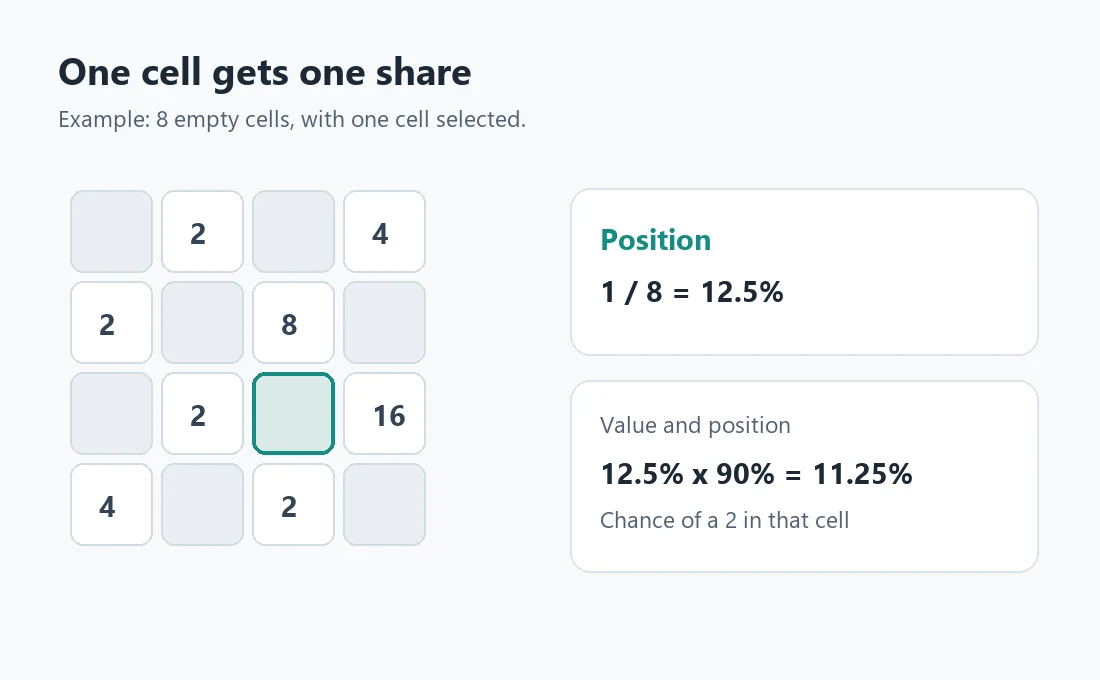
For example, with eight empty cells, the selected cell has a 12.5% chance of receiving any tile. Its 2 chance is 11.25%, while its 4 chance is 1.25%. With fourteen empty cells on a 4x4 board after the two opening tiles, the same cell's chances are about 6.43% for a 2 and 0.71% for a 4. More empty cells spread the position chance thinner; they do not change the overall 90/10 value draw.
| Empty cells | Any tile | A 2 | A 4 |
|---|---|---|---|
| 8 | 12.50% | 11.25% | 1.25% |
| 14 | 7.14% | 6.43% | 0.71% |
| 47 | 2.13% | 1.91% | 0.21% |
Does Cupcakes 2048 use the same rule?
The Cupcakes game manager preserves the same 2048 tile spawn probability model. Its source sets the opening tile count to two, chooses the value with a 0.9 threshold for 2 versus 4, and asks the grid for a random available cell. The original 2048 project uses the same value threshold and chooses a random entry from its available-cell list. Those first-party code paths are why the standard probability explanation also applies to the Cupcakes board.
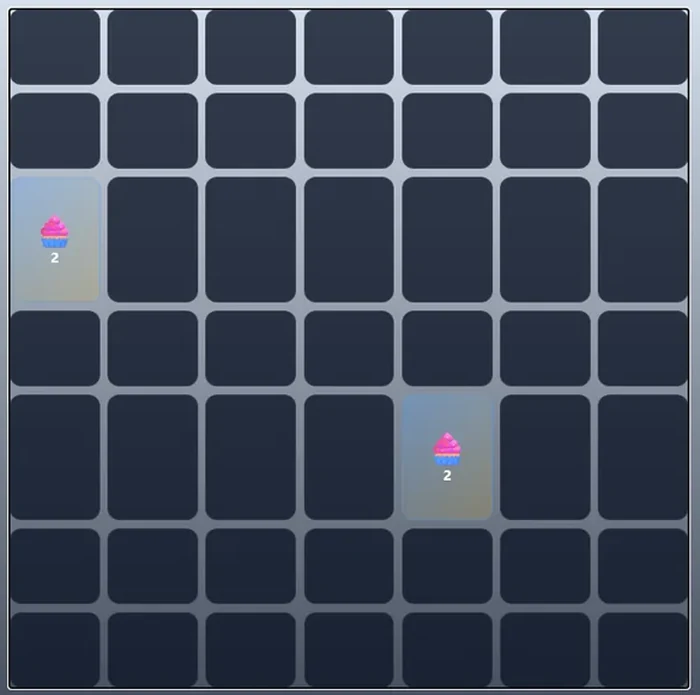
Board size changes the number of available positions, not the value odds. On a 7x7 board with two starting tiles, there are 47 empty cells after setup. A particular empty cell then has about a 2.13% chance of receiving any tile on the next spawn, including about 1.91% for a 2. The full board still gets a 2 on 90% of spawns and a 4 on 10%.
Why an invalid swipe adds no tile
An invalid swipe skips tile creation, so 2048 tile spawn probability only applies after a move changes the board. A swipe into a blocked edge is a no-op when no tile can slide and no pair can merge. The board stays exactly where it was, so the game does not choose a value or a location. Repeating the same blocked direction does not slowly build up a spawn chance; there is no queued tile waiting behind the move.
If one or more tiles move into open cells, or if equal tiles merge, the board has changed and the spawn routine runs once for that move. The number of tiles moved or merged does not create several spawns in one turn. This makes the practical rule simple: compare the board before and after the swipe. A changed board gets one new tile; an unchanged board gets none.
How to read streaks without mistaking them for a pattern
When reading 2048 tile spawn probability across a streak, treat each successful move as one new value draw rather than a promise about the next tile. Ten spawns average nine 2s and one 4, but the actual sequence might be ten 2s, or it might include several 4s. Under the usual independent-draw model, the chance of seeing at least one 4 across ten spawns is 1 minus 0.9 to the tenth power, about 65.1%. That is more likely than not, but still leaves a substantial chance of no 4 at all.
Use probability to describe risk, not to predict a fixed board. Count only the cells that are empty when a valid move finishes, then use the value and location rules separately. A larger board gives each named cell a smaller share, while a run of 2s does not make a 4 due on the next turn. For move planning, protect space and keep future merges open instead of chasing an expected tile at a guessed location.
2048 tile spawn probability FAQ
Source notes
The probability rules above were checked against the game implementations, not inferred from a short strategy tip. The random value check and empty-cell selection are separate source operations.
- Original 2048 game manager shows the 90/10 value draw, two starting tiles, and the spawn-after-change flow.
- Cupcakes 2048 game manager confirms the same starting-tile count and value threshold in the themed game.
Related Cupcakes 2048 pages
- Play Cupcakes 2048 · Try a move and watch a new tile appear only when the board changes.
- 2048 Cupcakes Strategy · Use corner control and a descending chain to plan safer moves.
- All Cupcakes and Tile Values · Identify the cupcake shown on a tile and see how values progress.